

Materiality assessments might feel like a new ESG trend, but it is a key part of building an ESG and sustainability strategy that adds value and delivers returns.
We never start a strategy design or reporting project with a client without doing some form of materiality assessment so here is our guide on what it is, how to get started and why it is important.
What is a materiality assessment?
A materiality assessment identifies which sustainability issues matter most to a business and its stakeholders. It answers two questions:
Which environmental, social, and governance issues create financial risk or opportunity for the business?
Which issues have the greatest impact on people, communities, and the environment because of the business's activities?
These two questions sit at the heart of double materiality, the approach now embedded in the Corporate Sustainability Reporting Directive (CSRD) with the UK taking a single, financial materiality approach. See our Guide to the new UK Sustainability Reporting Standards for more information.
Businesses have been reporting on their impact for a while, through carbon reporting, gender pay gap reporting and any voluntary impact reports. Where they often fall short is assessing and reporting what impact environmental, social and governance shifts have on their bottom-line.
Why is a materiality assessment important?
Materiality assessments are critical for determining where to focus resource. We often see two common issues in businesses:
Covering every topic, in a broad generic way that has little to no impact.
Focusing and investing in topics that are not material, meaning the impact on the business is minimal.
Alongside ensuring focus and investment in the right place materiality assessments are critical because:
Regulation now requires it. CSRD mandates a double materiality assessment as the starting point for reporting. UK-listed and large private companies are moving in the same direction.
Investors expect it. Investors want to know material topics are being managed properly, many now conducting their own assessment through the ESG due diligence process. When we work on investor’s behalf we often see companies missing key materiality topics, specifically around governance.
Builds credibility. When a company has a 50-page ESG report, a never ending ESG web page or social media posts for every awareness day on the calendar, it often acts as a red flag for greenwashing. Focused, impact-driven action builds trust across all stakeholders.
The key steps
1. Identify the universe of issues
Start broad. Pull together a long list of potential ESG topics using recognised frameworks (GRI, SASB, ISSB) as a starting point. You might choose to reduce the list based on your sector and geography at this point. We recommend not reducing it too much as it may guide the process based on your opinion rather than being the stakeholder-informed, robust approach it should be.
2. Map stakeholders
Identify who has a stake or interest in your business. This will likely be employees, customers, investors, suppliers, regulators and local communities. But it may also include NGOs, industry bodies, graduates (your future workforce) media or other groups.
3. Gather input
This is where assessments succeed or fail. We normally do a combination of multiple techniques to gather the richest, most useful input. This includes:
Structured interviews with senior leaders and investors
Employee focus groups
Supply-chain mapping across sectors and geographies
Surveys across supply-chains and customers
Extensive desk research of your largest customers
Competitor analysis
Sector research including the sector where you operate and the key markets you sell to.
Horizon scanning of the regulatory landscape, using both digital tools and sector bodies.
The aim is to collect data and insights across every stakeholder group mapped. The more data points the richer the output.
4. Analyse
It is common to make errors here. Often people look at the vast data collected and make assumptions which are influenced by personal views, not necessarily data-informed.
Instead, we recommend mapping each stakeholder group ranking the sustainability topics on level of importance. This tells you the important topics per group.
5. Scenario test
Everyone misses this step! It’s the probable “what ifs” and how they might impact your business.
As part of TCFD (if you want to get your head around the alphabet soup of ESG check out our glossary of terms [LINK]) many businesses already scenario plan for climate change. They answer questions like, “what happens to our customers if global temperatures rise by 3°?” or “what happens to productivity during a heatwave?”
But scenario testing should go beyond climate change. Now that you have 3/5 key issues per stakeholder group, it is valuable to test the impact with probable scenarios such as:
If we have a cyber attack and we cannot access systems for 1 day what is the impact?
What happens if we have a data protection breach, and how will this impact consumer trust?
If our critical supplier was found to have child labour, what impact does this have on our reputation and product?
We recruit specific engineering skills, if graduate figures decline due to the cost-of-living crisis, what impact does that have on our 10-year growth plan?
For every ESG issue there will be 3-5 scenarios that are likely. Mapping these and working with finance to cost them is a valuable task that provides concrete financial impact estimates.
There are scenario planning tools available however an internal workshop with your own experts will be the most impactful way to deliver this. At ENVOLV we deliver these workshops to inform the materiality assessment but importantly gain internal sponsorship and accountability. When real-world scenarios are documented, the conversation around the importance of ESG shifts.
6. Score and plot
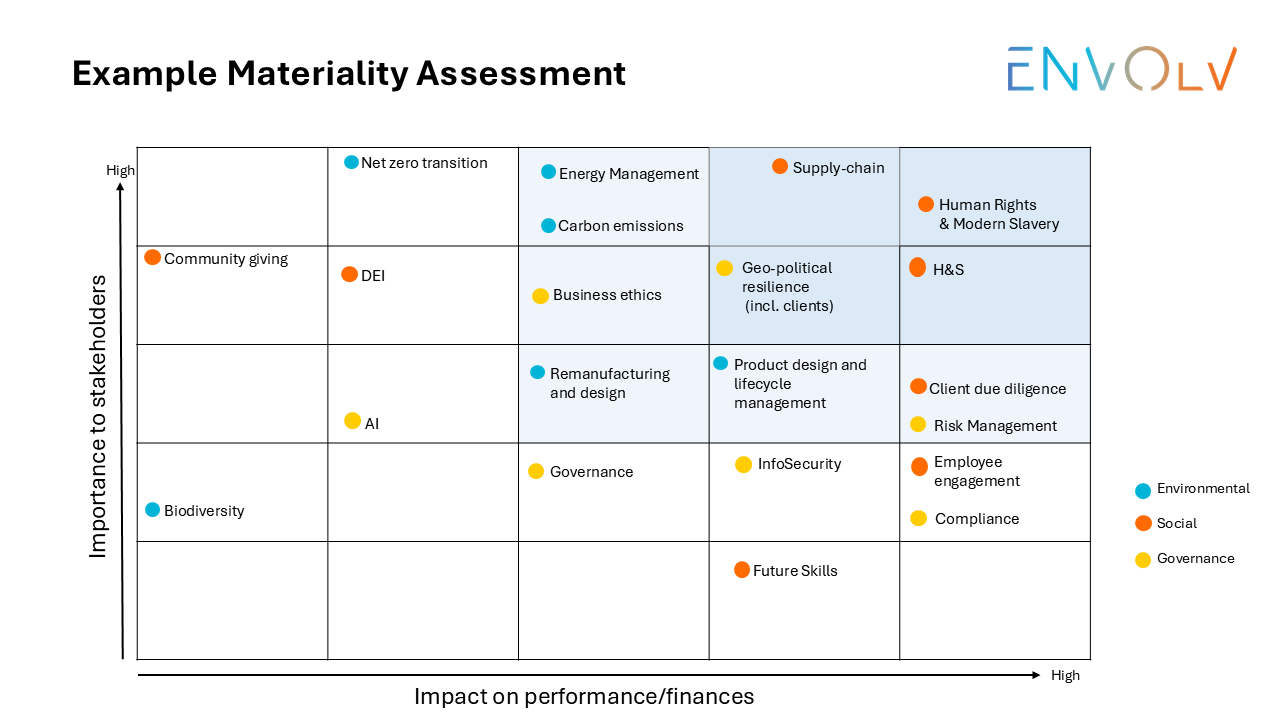
Now you have a clear ranking for each topic; from stakeholder insights and scenario testing. Score each issue on two axes: financial materiality (risk and opportunity to the business) and impact materiality (effect on people and planet).
Plot the results. Issues that score highly on both axes are your priorities.
7. Validate
Take the results back to the business. They should be tested by your employees, Executive Committee and importantly, your Board. If possible, test them externally with a few key suppliers, customers, investors and/or your industry body.
8. Embed and revisit
We recommend embedding the materiality process into your Risk and Audit Committee. Material topics should have risk statements that are regularly reviewed, managed and controls tested. They should be regularly report to your Executive Committee and Board. This is good governance.
Materiality assessments should be reviewed at least every two years however we strongly recommend building horizon scanning into your business. Geo-political and climate shocks are not foreseeable, but they are often predicted, as is regulatory, economic and industry disruptions. Horizon scanning strengthens your resilience. At ENVOLV we provide retained strategic leadership support that includes horizon scanning.
Common pitfalls
Seeing materiality assessments as a tick box and missing the strategic value.
Relying on your team or ESG Committees views with no to little stakeholder involvement.
Covering every topic equally with generic approaches that aren’t designed for the uniqueness of your business.
Thinking ESG and sustainability is about carbon emissions and charitable donations.
Guessing the financial impact rather than scenario testing and modelling with your Finance Team.
Reporting everything without clear targets, metrics or controls aligned to risks and opportunities.
Getting started
A materiality assessment done properly gives a business the clarity and focus needed to inform a strategy that supports growth and resilience. Done poorly it sits in a drawer adding no value.
Completing a materiality assessment that works takes time, resource and expertise. Treating it like a project is critical.
We help companies complete materiality assessments that stand-up to regulatory requirements and investor scrutiny. Most importantly our materiality assessment will add value. Here are two key examples of how we have impacted clients:
Through a materiality assessment we identified a market opportunity for a client, that hadn’t been explored or invested in. As a result of the assessment, a business case was agreed and that new market revenue grew by 142% in 2 years (circa £13m annual revenue).
A client was advised to invest over £1m in a carbon reduction project. They asked our opinion. Through a short and sharp materiality assessment we were able to advise the investment would only reduce emissions by 13% and that this was not a material topic to the business. The focus should be elsewhere given customer and investor priorities.
From full project management to advice and mentoring, we will provide the best support for you. To discuss getting started with materiality, get in touch.