
ESG Is Now Priced Into Your Lending Rate
A growing number of lenders are incorporating ESG into their lending decisions. And in some cases, offering preferential rates if annual targets can be met by the borrower. This sizeable shift should be getting noticed by CFOs and Finance Directors across the globe.
Grant Thornton UK LLP, ESG lending study (2024) highlights that 73% of mid-market lenders now have a formal sustainable lending policy, often driven by growing reporting compliance requirements facing financial institutions.
Why lenders are moving this way
Alongside this there is mounting pressure for lenders to understand the risks within their lending portfolio, beyond the traditional financial performance risks. Already we are seeing climate risks materialise and impact revenue, operating costs and insurance premiums. Assessing ESG risks in lending decisions seems unavoidable.
And research suggests this is only going to grow. 81% of mid-market lenders expect ESG performance to play a more important role in lending decisions in the coming 5 years (ESG lending study 2024).
What lenders now expect
In reality this means ESG disclosures need to move beyond compliance and provide a solid, evidence-based report of material ESG risks to a business. For us, the new UK Sustainability Reporting Standards provide an excellent framework for this.
Using double materiality assessments to identify and score risks.
Detail the risks, how they are assessed, mitigated and managed.
The metrics that monitor the risk and targets that reduce exposure.
How ESG risks are integrated into organisational strategy.
What governance structures ensure effective oversight is in place.
Our blog on UK SRS provides more details.
How incentives works
What is interesting though is how lenders are incentivising effective management of ESG risks. This isn't new. However, it is something we are seeing more of.
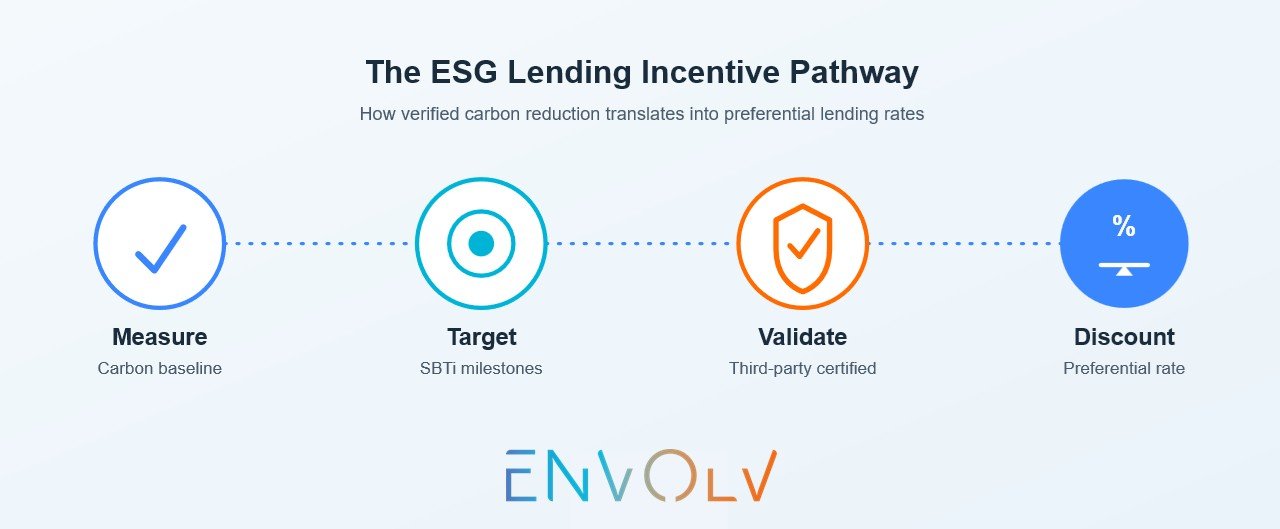
What does this look like? The most common situation we see is discounted rates if annual carbon reduction targets are achieved.
In order to do this, businesses need to measure their carbon footprint to set a baseline. Then set Science Based Target initiative net zero target with annual milestones. And the critical part, have this data and target validated by a certified third party.
The result? A discount which improves your bottom line. For example, a £5m loan with a 7% interest rate, could achieve a saving of £75,000 over 3 years, if their annual carbon reduction target is met. And importantly, independently validated.
In some cases, we have seen lenders look beyond carbon targets to include diversity targets and other material risk reducing measures.
Where things get challenging
A challenge we often see is Finance Teams not being involved in carbon accounting until a lender opportunity materialises. A time sensitive shift then needs to happen and often leads to failure to secure this incentive.
The key challenges we see are:
Trying to build auditable carbon reports for the first time, under time pressures, with teams who don't understand the process (it takes 2 years of reporting to build that habit and knowledge in our opinion).
Carbon reports that lack methodology and quality assurance.
Targets that were set historically, with no reduction plan to meet annual targets.
Carbon audits can take months (on-boarding partners, data sharing, queries, corrections, certification).
Why Finance Teams are critical contributors
Finance Teams can provide key skills to carbon accountancy. They already operate in a manner that focuses on traceability, consistency and procedure. All essential in delivering an auditable carbon report.
Many businesses still operate with sustainability being one person's role, or a side project that doesn't get focus. When in reality Finance Teams can help improve reporting quality. Property, operations, tech and procurement teams often own the emissions source. Company Secretariat, risk and compliance teams influence how ESG oversight is implemented.
Getting ready
There is growing evidence sustainability performance influences financing. It has been priced into investment and M&A deals for some time. Now seeing the incorporation into lending and credit products is not surprising.
Even if these products are not on offer to you today, it is essential to acknowledge risk assessments during financing will include ESG. And incentives to lower those risks will become more common. The same ESG lender study highlights that 93% lenders think regulators may introduce a requirement to integrate sustainability into banks' internal capital allocation models for loans.
For large businesses, this will likely not be new information but for mid-market the opportunity to demonstrate low risk through structured ESG risk management and reporting is obvious.
Whether you are having conversations with lenders or you want to get prepared for future conversations, ENVOLV can provide advice through to building the reporting and reduction plans you need to access sustainability-aligned lender agreements. Get in touch to start the conversation.