
What Does Good Governance Look Like? A Practical Guide for Organisations

Governance is one of those words that can make something relatively straightforward sound unnecessarily complicated. Policies. Committees. Terms of reference. Reporting structures. Board papers. Risk registers.
All of these things have a place. But having them doesn't necessarily mean you have good governance. This is a common misconception we see. Due diligence boxes are ticked because on paper you have what you need, but the reality is operational gaps, slow decision-making, stalling progress and a lack of resilience.
Good governance is about making sure the right people are making the right decisions, with the right information, at the right time. It creates clarity about who is responsible for what, where accountability sits and how an organisation knows it is doing what it said it would do.
When governance works well, you often barely notice it. Decisions happen at the right level and the right speed, people understand their responsibilities, risks are identified early and managed, and leaders have enough oversight without becoming too involved in operational detail. Resilience and adaptability grow which is critical in the fast paced changing market we face today.
When governance isn’t as effective as it needs to be, issues may not appear immediately but stagnant growth, heightened risks and lower valuation are common outcomes.
What does good governance look like in practice?
There is no single governance model that works for every organisation. In fact, one of the problems we see is organisations adopting structures because they look like good governance rather than because they genuinely help the organisation operate better. Good governance should be proportionate to be effective.
One mistake we see is organisations adding new governance layers when something goes wrong. New committees are formed, 10-page long policies are drafted, a new report is designed. More work is added but nothing really changes and the original problem is still there. It is often not about increasing the volume of governance processes but improving the quality.
A growing SME doesn't need the governance infrastructure of a national public body. Equally, a large charity managing significant public funding needs more than an annual strategy meeting and a collection of policies.
For some, governance is influenced by law:
For UK businesses the Companies Act 2006 which defines directors’ duties, shareholder rights, meetings and voting, accounts and reporting, remuneration reporting and votes, audit requirements, and filing obligations at Companies House.
For UK charities the Charities Act 2011 (as amended by the Charities (Protection and Social Investment) Act 2016 and Charities Act 2022), defines what a charity is, sets out trustee duties and powers, registration and reporting to the Charity Commission, fundraising controls, and the Commission’s regulatory powers
Good governance is not only about delivering as per regulatory requirements, but ensuring the right structures are in place to strategically deliver, manage risks and build resilience.
Clear roles and responsibilities
Employees, Directors, Non-executive Directors, Trustees: must understand where their responsibility starts and stops.
The Board has a documented Terms of Reference and understands its role. Board meetings are structured, recorded and timely. Delegation of responsibility to sub-committees is clear with reporting to the Board documented.
Common sub-committees include:
Risk and Audit Committees
Remuneration Committees
ESG/Sustainability Committees.
Senior leaders know what they are accountable for. It needs to be clear what requires Board approval and what decisions can be made. A common challenge we see is Boards becoming too operational, and at times veering more into leadership. This causes tensions and blurs accountability.
A helpful tool, to clearly document roles is a RACI (responsible, accountable, consulted, informed).
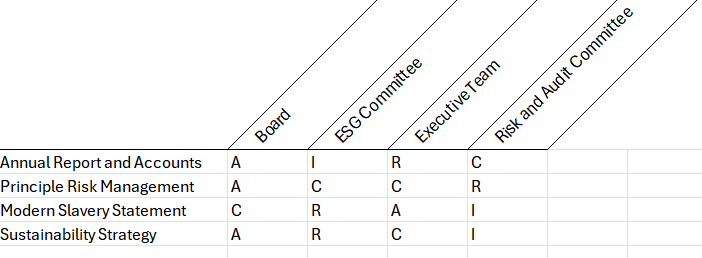
New Board members also need a proper induction. Unclear accountability often starts before someone's first Board meeting. A new Director or Trustee who isn't properly inducted is more likely to be unclear on their responsibilities, and less likely to challenge effectively early on.
A good induction typically covers the Terms of Reference, delegated authorities, key policies, recent board papers and minutes. We also recommend spending time with teams, in services and getting hands-on insight into the business.
This sounds basic, but unclear accountability is behind a surprising number of organisational problems. When ownership is vague, decisions are delayed, work is duplicated and risks go unmanaged. Good governance removes ambiguity.
Board composition and effectiveness
The Board itself needs to be fit for purpose. Good governance isn't only about what the Board does. It's also about whether the Board is the right group of people to do it. That means asking a few uncomfortable questions regularly, not just at recruitment:
Does the Board collectively have the skills and experience the organisation needs now, not just when it was formed?
Is there a plan for succession, so the organisation isn't exposed if a Chair or key Trustee steps down?
Does the Board evaluate its own performance, not just the organisation's?
A skills matrix and a simple annual Board evaluation are two of the lowest-effort, highest-impact governance tools available. Both are frequently requested in due diligence and funder assessments, and their absence is often more telling than their presence.
Common skills to have on your Board is finance, legal, HR, Marketing, and operational/sector specific. But this varies depending on the Terms of Reference, what the most material risks/opportunities to your organisation are and timing. For example, during investment cycles it is often helpful to have a Board member who has been through that experience previously.
The Board has useful information, not simply more information
A 70-page board pack is not necessarily evidence of strong governance. Good board reporting should help Trustees or Directors understand performance, risk, finances, impact and the decisions that require their attention.
The question should always be: what does the Board need to know to govern this organisation effectively? Good information creates better discussion, challenge and decisions.
A common conversation we are seeing is Board members using AI to summarise Board packs that are simple too long and complex to digest. One connection shared that in their recent Board meeting most Directors had used ChatGPT and as a result had almost identical thoughts, challenges and questions. This dilutes expertise and the impact a Board should have.
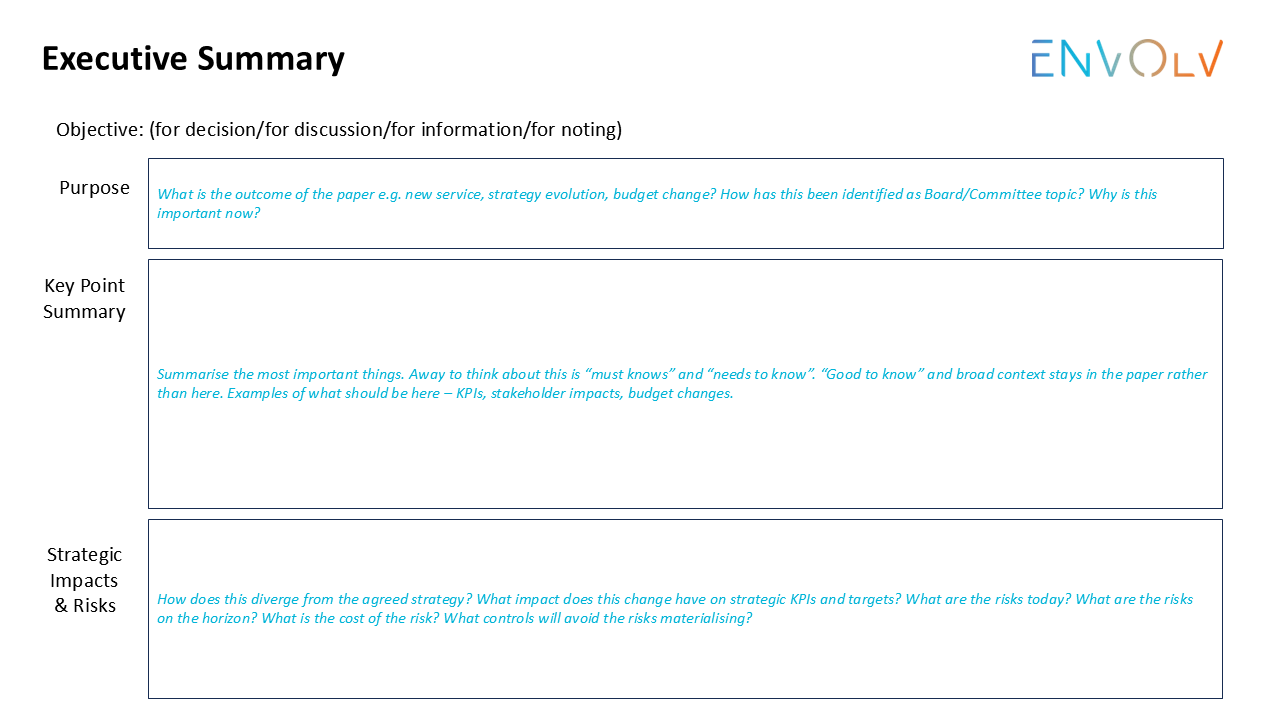
Concise, proportionate Board papers are critical. We use this simple front-page template to help Board members see the most important information quickly.
Risk is part of decision-making
Principal risks, emerging risks and operational risks should be documented, with clear mitigation actions, controls and reporting metrics. But having the operational process to identify, assess, mitigate and manage risks is only effective if there is a strong risk culture.
Good governance means risk informs decisions as they are being made. Leaders understand the organisation's principal and operational risks, but more importantly is horizon scanning for emerging risks and risks that will materialise as a result of the decision being made.
The Board should dictate the risk appetite of the organisation. Every opportunity will have a level of risk and being clear and incorporating this into decision-making should be common practice.
Managing Conflicts of Interest
Conflicts of interest are managed, not just declare. Every organisation will encounter conflicts of interest at both Board and Leadership level. Good governance isn't about avoiding them. It's about having a clear process to identify, declare and manage them when they arise.
This typically means:
A conflicts of interest register, reviewed regularly rather than completed once
A standing agenda item at Board and committee meetings for new declarations
A clear process for what happens next, for example a conflicted Director stepping out of a discussion or vote
Without this, even well-intentioned decisions can look compromised. And in charities in particular, this is a specific area regulators and funders scrutinise closely.
Where ESG and sustainability sit in the governance framework
Sustainability and ESG are increasingly part of core governance, not a side conversation. Where they sit in the structure matters. Some of the questions we help organisations work through:
Who owns ESG and net zero targets at Board level, and is that clearly documented in the same way as financial oversight?
Is there a Sustainability Committee, or is ESG a standing item for the full Board? Either can work, but it needs to be a deliberate choice, not a gap
How is sustainability data quality assured before it reaches the Board? Poor data leads to poor decisions and, increasingly, regulatory and investor scrutiny
Are reporting frameworks such as TCFD or ISSB reflected in how the Board receives and reviews information, or is sustainability reporting produced separately from core governance reporting?
Treating ESG oversight as part of the same governance discipline as financial and risk oversight, rather than a separate strand, is one of the clearest signs of a mature governance framework. It is also becoming a compliance requirement under the new UK Sustainable Reporting Standards. You can read more about this here.
Governance is not just the Board's responsibility
There can be a tendency to think of governance as something that happens in the boardroom. It doesn't.
The Board ultimately have important governance responsibilities, but good organisational governance relies on everyone understanding their part in it.
We have seen employees open new customer accounts in new geographic markets, because they simply didn’t know entering a new geography is a Board decision within the governance framework. The impact was exposure to legal and regulatory requirements the company was not prepared for.
Clarity is critical. Having clear structures and transparent communications about the Board, committees and decision-making help build organisational understanding.
If the role of a leader, manager and team member is not clear and responsibilities aren’t connected, even a very capable Board will struggle to govern effectively.
Governance is therefore not simply a Board issue. It is an organisational system.
Why good governance matters
The purpose of governance isn't to create more process. It is to help an organisation perform better while protecting it from unnecessary risk.
Strong governance can improve decision-making, clarify accountability, strengthen financial and risk oversight and give Boards and leadership teams greater confidence in organisational performance.
It also matters externally.
Funders, investors, commissioners, regulators, members and partners increasingly want confidence that the organisations they work with are well run.
For charities and organisations receiving public funding in particular, demonstrating strong governance can be fundamental to maintaining trust.
For businesses good governance can impact financing, investment and valuation. Poor governance will come up in due diligence. 53% of investors state material ESG due-diligence findings had resulted in cancelled deals and 42% resulted in purchase-price reduction.
There is a cost to poor governance, and sometimes it can mean the survival of your organisation.
When should you review your governance?
Governance shouldn't only be reviewed when something has gone wrong.
Periods of change are particularly useful times to look at whether existing structures are still fit for purpose. That might include organisational growth, a new strategy, changes to the leadership team or Board, new funding arrangements, increased regulatory requirements, or a significant change in services.
There are though subtle signs your governance standards are slipping. Meetings become increasingly operational. Decisions are revisited or changed. Board papers get longer. Agreement happens with little discussion or challenge.
Individually, these can seem like relatively small frustrations. But we often see these quickly escalate into frustrated leadership teams, stunted growth due to slow decision-making, or a lack of adaptability when market or geopolitical shifts happen.
How to review your governance
A governance review doesn't need to be a lengthy external exercise, and for most organisations, it shouldn't be. A proportionate process typically includes:
Someone independent enough to ask honest questions, whether that's a Board member without an operational role, an advisor, or an external reviewer for larger or more complex organisations
A short structured conversation with the Board and senior leadership about what's working and where friction shows up
A review of core documents: Terms of Reference, delegated authorities, risk register, recent board papers
Reviewing and testing the controls documented in organisational policies
A small number of practical recommendations, not a lengthy report that becomes another document nobody reads
A common recommendation we make is operationalising policies. Often, they sit in shared drives, unread and not in use. This means the risks or compliance requirements they are designed for appear to be managed but in reality, are left unchecked. Common gaps are around conflicts of interest and human rights.
Our perspective
At ENVOLV, we don't believe good governance means adding another layer of bureaucracy. Good governance usually makes an organisation simpler to run. It creates clarity and protection for everyone. It gives leaders the space to lead and Boards the confidence to provide effective oversight. This is where we get excited because governance should add value and be beneficial to everyone.
Sometimes that means introducing a new process or strengthening a governance framework. Often it means removing duplication, simplifying reporting or being much clearer. We always opt for simple but effective, when we conduct governance audits and improvement plans.
If you have read our blog and you think you have governance gaps, or it is viewed as a tick box, then maybe our governance audit would be the perfect starting point. Get in touch to find out how to get started.