
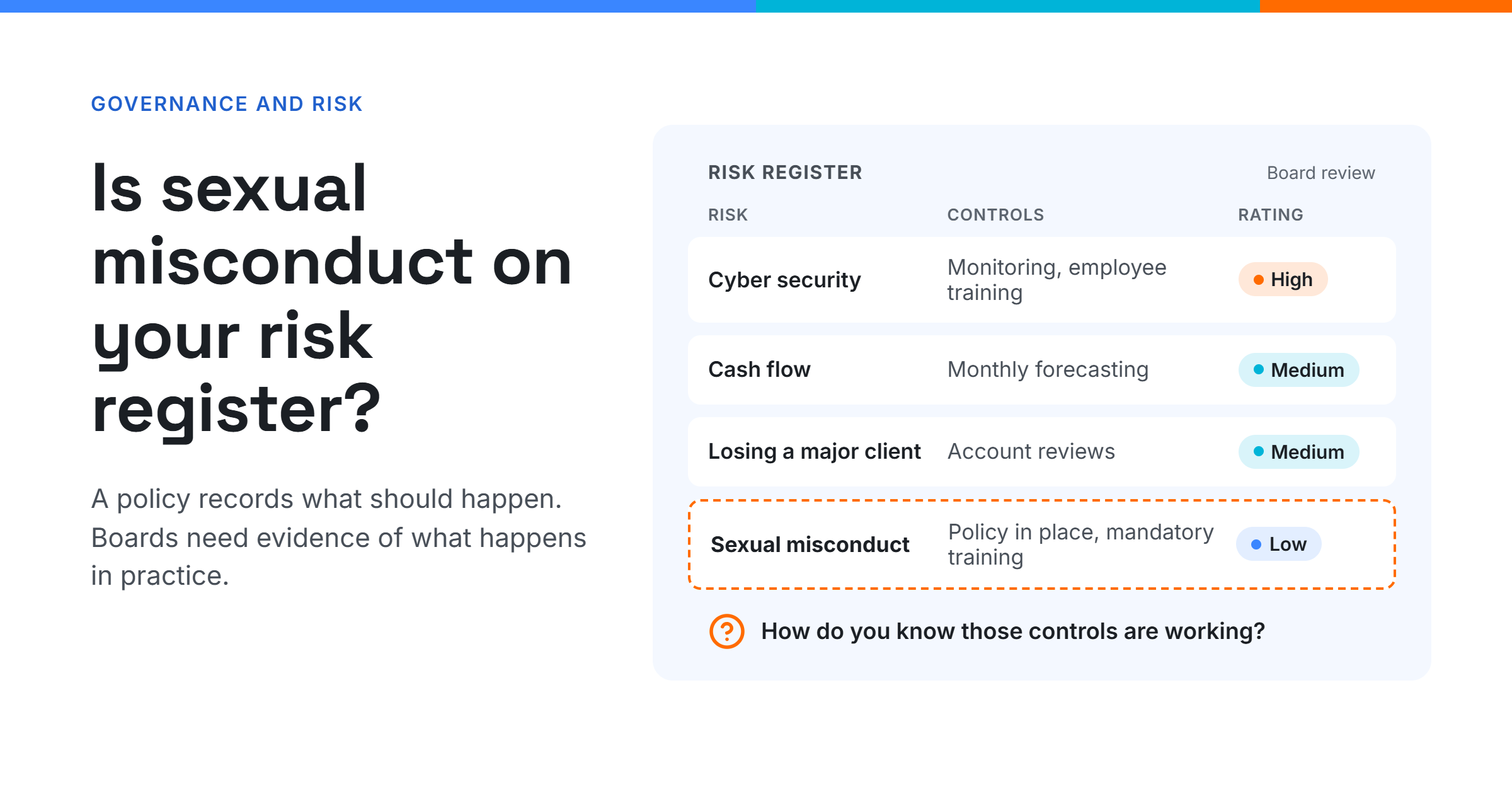
Risk registers across any business have a lot in common. Cyber security, macro-economic shifts, supply-chain issues, are all familiar entries. Sexual misconduct though might receive less attention. Perhaps it sits somewhere under “people risk”; a bucket that captures a lot of risks and is often overly simplified. You have an anti-harassment policy or it is included in your employee code of conduct, so everyone assumes it is covered.
But if someone asked your board tomorrow how it knows those controls are working, what would the answer be?
The harm starts before the headlines
The first consequence of sexual misconduct is the harm to the person experiencing it. That should be reason enough to take prevention seriously. We have seen that harm played out in the media with high profile bosses and celebs throughout 2026.
There are also consequences for the wider organisation: people leaving, trust breaking down, management time diverted, legal costs and damaged relationships with customers, funders or investors. And those consequences will last far longer than any headline.
By the time an issue becomes public though, there may already have been opportunities to identify and address it. That makes this a question of governance. Knowing who is responsible for acting on allegations or rumours, having escalation measures in place and transparently reporting issues, all sit within an organisations governance framework.
A policy is a starting point
Imagine a Board reviewing its risk register. Sexual harassment is listed. The controls column says “policy in place, mandatory training, whistleblowing procedure”. The risk is rated low. It looks reassuring.
But the real question is whether employees know where to raise a concern about their leader. Whether the organisation would challenge a major client whose behaviour crossed a line. And whether employees have confidence in the complaints or grievance process. The risk starts to look different when you start to dig into what we have on paper versus what happens in reality.
A policy records what should happen. Board assurance needs evidence of what happens in practice. As we explore in our guide to good governance, clear responsibilities and useful information are essential to effective oversight.
One aspect of policy we see frequently getting missed is the Supplier Code of Conduct. This should set out the behaviours you expect from people working with your organisation, alongside the usual commercial and compliance requirements. Including sexual harassment as non-compliance with supplier expectations alongside how to raise concerns, can be powerful prevention measures.
We recommend your expectations around behaviour are clearly communicated during supplier onboarding. A link on your invoices to your Supplier Code of Conduct can also help keep it visible and acts a small reminder, following that initial conversation.
Prevention needs evidence
Sexual harassment has a specific legal meaning, and the prevention duties matter. Since 30 October 2026, employers in Great Britain must take all reasonable steps to prevent sexual harassment. The strengthened framework also addresses harassment by third parties, such as customers and clients. Acas guidance on preventing sexual harassment is a useful read as it explains the requirements and practical considerations.
For Boards, the useful question is: can we demonstrate that we have assessed the risk and taken all reasonable sets to prevent it?
Adding a line to a risk register does not, by itself, demonstrate compliance. The assessment, action and scrutiny that comes from adding sexual misconduct to your risk register is the real value.
What should the risk register capture?
The wording should make the actual risk visible. “Reputational damage from allegations” is too narrow. It overlooks both the harm and the failures that could allow it.
A more useful starting point might be: Failure to prevent, identify or respond appropriately to sexual misconduct, resulting in harm to people and loss of organisational trust.
Then apply the same discipline you would to other significant risks:
Exposure: Where could harm occur, and what makes it more likely?
Ownership: Which senior leader is accountable, and who provides Board oversight?
Controls: What practical measures reduce the risk?
Assurance: What evidence shows those measures are understood and working?
Action: What gaps remain, who will address them and by when?
Whether this needs its own entry or sits within a broader risk depends on the organisation. What matters is that it remains visible and receives appropriate scrutiny. Having sexual misconduct in your risk register does mean it gets talked about at every risk review; that in itself is powerful.
Would someone feel safe speaking up?
A recent conversation at a networking event made me think about how important it is to test speaking up processes actually work. At the event we got chatting about whistleblowing (don’t ask how!). The organisation has a helpline, but no one had ever used it. I asked a few questions and it became clear the number is buried in a policy on the intranet.
My advice was simple, make it easy to find. Include it in employee inductions, put it somewhere obvious on the intranet and remind people about it. If your colleagues are on-site or in the office, hang posters in break areas and leave cards in various physical locations. Someone weighing up whether to speak out should not also have to hunt for the number.
Having processes to complain and formal whistleblowing doesn’t need to include an external helpline. There are options like having anonymised email inboxes. Having a clear point of contact that is in a trusted role is also important. Often organisations jump to this being HR but often your legal counsel, business ethics team or company secretary are better placed. In one company we even saw the Data Protection Officer hold the role which worked really well due to his reputation for integrity.
You need to consider the employee whose concern involves the person who approves their promotion. Or the colleague worried that reporting a valuable customer will make them seem commercially difficult. Would they know where to go? Could they bypass the person involved? Would they trust the organisation to protect them from retaliation?
Boards should understand how complaints, whistleblowing and other reporting routes fit together. There needs to be options that ensure employees feel heard and safe.
Often we hear comments like “no one complained before”. Having no complaints doesn’t mean your controls are working. You need to measure other metrics to understand if they really are working. Employee feedback surveys, Board sessions with employees, exit interview responses and broader people data can help Boards. Oversight should focus on patterns and the effectiveness of the risk management which this data will help deliver.
Put it on the next Board agenda
The Board shouldn’t be involved in individual cases. Instead the Board needs to be satisfied that appropriate arrangements exist, responsibilities are clear and concerns can reach someone able to act.
When was the last time your Board reviewed the risk register? Was sexual misconduct captured as a risk?
ENVOLV’s board and leadership advisory support helps organisations strengthen governance, risk oversight and accountability, working alongside their HR and legal advisers where specialist advice is needed. If you are reading our blog and can see gaps in how you manage risks, get in touch.